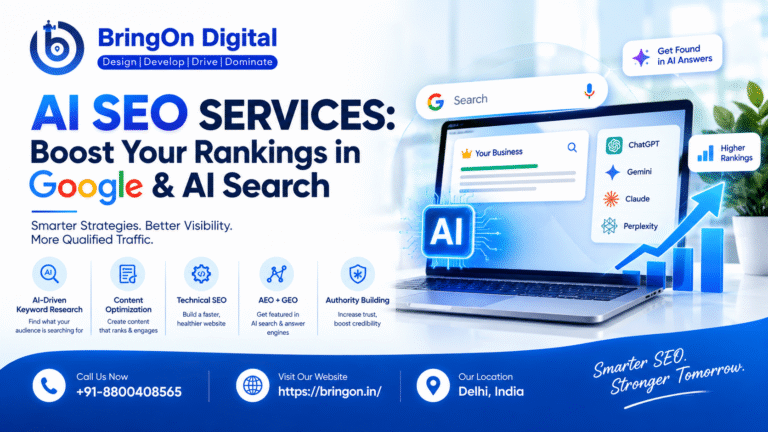

AEO (answer engine optimization) is the practice of shaping your content so that AI assistants and search features can pick it up and use it as the direct answer to someone’s question. Where classic SEO aims for a click from a list of blue links, AEO aims for your brand, facts and wording to appear inside the answer itself, ideally with a citation back to you.
In practice, AEO and SEO overlap heavily. The same page that ranks well usually feeds the answer. AEO adds a sharper focus on clear questions, direct answers, structured data, consistent entity information and being cited by sources that AI systems trust. This guide covers where answers appear, how AEO differs from SEO and GEO, a step-by-step checklist, a before-and-after rewrite and how to measure results.
Where answers appear today
When people talk about “answer engines”, they mean any surface that replies with a composed answer rather than a list of results. The main ones you should care about are:
- Google AI Overviews: the AI-generated summary shown above or among regular results for many queries, with links to the pages it drew from.
- Google AI Mode: a conversational search mode where users ask follow-up questions and get longer, cited answers.
- Featured snippets: the older, extract-style answer box that quotes a passage from one page. It still appears for many definition and how-to queries.
- ChatGPT search: ChatGPT can search the web and cite sources when a question needs current information.
- Perplexity: an answer engine built around search, which shows numbered citations for nearly every answer.
- Gemini and Microsoft Copilot: assistants that draw on Google and Bing search respectively and can cite web pages.
- Voice assistants: Google Assistant, Siri and Alexa often read out a single answer, so only one source gets credit.
AEO vs SEO vs GEO
These three terms are often used loosely, so here is a practical way to separate them:
- SEO (search engine optimization) improves how your pages rank in traditional search results. Success is measured in rankings, impressions, clicks and conversions.
- AEO (answer engine optimization) focuses on being the source used for a direct answer, whether in a featured snippet, an AI Overview, a voice reply or a chatbot. Success is being quoted or cited.
- GEO (generative engine optimization) is a newer label for optimizing specifically for generative AI tools such as ChatGPT, Gemini and Perplexity, including how your brand is described when no link is shown at all.
The honest summary is that AEO and GEO are extensions of good SEO, not replacements. If Google cannot crawl and understand your page, an AI system built on Google’s index is unlikely to cite it either. Treat AEO as an extra layer on top of solid technical SEO, useful content and authority. If you want the wider picture of how AI is changing search work, our guide to AI SEO services and Google AI search goes deeper.
How answer engines choose sources
Most AI answers today use a process often called retrieval-augmented generation. The system turns the user’s question into one or more searches, retrieves a set of relevant pages or passages, then writes an answer based on those passages and links to some of them.
That has three practical consequences. First, you need to be in the index the engine searches (Google’s, Bing’s or the engine’s own crawler). Second, the engine works at passage level, so a single clear paragraph can be pulled out even from a long page. Third, the model tends to favour statements that agree with other sources, so consistent facts about your business across the web matter more than they used to.
A step-by-step AEO checklist
1. Research the questions people actually ask
Start with real questions, not keywords alone. Look at Google’s People Also Ask boxes, the queries in your Search Console Performance report that start with who, what, how, why or which, questions your sales and support teams hear every week, and threads on Reddit or Quora in your niche.
Group the questions by intent. Some deserve a dedicated page, others belong as a section or FAQ on an existing page. Avoid creating dozens of thin pages that each answer one tiny variation.
2. Use answer-first formatting
Put the direct answer in the first one or two sentences under the relevant heading, then expand. Use the question, or a close version of it, as the H2 or H3. Keep the answer self-contained so it still makes sense when quoted on its own, without “as mentioned above”.
Name the thing you are explaining instead of relying on pronouns, because a quoted passage loses its surrounding context.
3. Add structured data where it fits
Schema markup helps machines understand what a page is about and who is behind it. Useful types include Organization (name, logo, contact details, social profiles via sameAs), Article with author information, Product, LocalBusiness and BreadcrumbList.
Be realistic about FAQPage and HowTo. Google has limited FAQ rich results to well-known government and health sites and has stopped showing HowTo rich results. You can still use FAQPage markup where a page genuinely has a question-and-answer section, as it describes the content accurately, but do not expect visual rich results from it. Only mark up content that is visible on the page.
4. Keep your entity information consistent
AI systems build a picture of your business from many places. Make sure your name, address, phone number, services, founding year and key people match across your website, Google Business Profile, LinkedIn, directories and any press coverage. Contradictions make it harder for a model to state facts about you confidently.
A clear About page and an Organization schema block linking to your official profiles help tie these signals together.
5. Show authorship and real expertise (E-E-A-T)
Google’s guidance on helpful content stresses experience, expertise, authoritativeness and trust. Put real author names and short bios on articles, explain how you know what you know, include first-hand examples, cite primary sources and keep content updated with a visible date.
6. Make sure AI crawlers can reach your content
Check your robots.txt file. Many sites block AI crawlers by accident through broad rules or security plugins. Common user agents include Googlebot (which also powers AI Overviews and AI Mode), Bingbot (used by Copilot and others), OAI-SearchBot and ChatGPT-User for ChatGPT search, GPTBot for OpenAI model training, and PerplexityBot.
Note that Google-Extended controls whether your content is used to train and ground Gemini models; it does not remove you from Google Search or AI Overviews. Decide deliberately which bots you allow. Also make sure important text is in the HTML rather than only loaded by JavaScript, and that pages load quickly without blocking firewalls.
7. Earn citations and mentions
Answer engines lean on sources that other reputable sites already reference. Mentions in industry publications, local news, comparison articles, podcasts and well-moderated communities all strengthen how often and how confidently your brand is named. This is where AEO meets digital PR: useful data, expert commentary and genuine relationships with publishers.
Example: rewriting a paragraph for answers
The two paragraphs below are an illustration written for this guide, not taken from a real site. Imagine a page targeting the question “How long does a website redesign take?”
Before (weak): At our agency we believe every project is unique and we pride ourselves on delivering quality results for clients. Many factors come into play, and our experienced team will work with you closely to understand your needs before giving you a timeline that suits your business.
After (answer-first): A typical website redesign for a small business takes around 6 to 12 weeks. A brochure site with up to 15 pages sits at the shorter end, while e-commerce or custom-built sites take longer. The biggest factors are content readiness, the number of templates and how quickly feedback is given at each review stage.
The second version answers in the first sentence, gives a usable range framed as typical, names what changes it and can be quoted on its own. That is the kind of passage an AI Overview or featured snippet can lift.
How to measure AEO
There is no single AEO dashboard yet, so combine a few sources:
- Google Search Console: AI Overviews and AI Mode traffic is included in the Performance report under the Web search type, though not broken out separately. Watch impressions and clicks for question-style queries and for pages you have rewritten.
- Featured snippet and AI Overview tracking: many rank-tracking tools now flag when a keyword shows an AI Overview and whether your domain is cited.
- Manual checks in AI tools: keep a list of 20 to 30 important questions. Once a month, ask them in ChatGPT, Perplexity, Gemini, Copilot and Google AI Mode, and record whether your brand is mentioned, cited or described accurately.
- Referral traffic: in Google Analytics, look for sessions referred from chatgpt.com, perplexity.ai, gemini.google.com and copilot.microsoft.com.
- Branded search: a rise in searches for your brand name in Search Console can indicate people heard about you in an AI answer.
Common AEO mistakes
- Burying the answer under long introductions, brand stories or keyword-stuffed openers.
- Publishing thin FAQ pages that repeat the same generic answers found everywhere else.
- Adding schema that does not match the visible content, which can be treated as spammy structured data.
- Blocking AI or search crawlers by accident in robots.txt, a CDN firewall or a security plugin.
- Inconsistent business details across your site, profiles and directories.
- Ignoring off-site reputation, assuming on-page changes alone will make AI tools mention you.
How BringOn can help
BringOn Digital has worked on search for clients since 2017 and runs AEO and GEO as part of its AI SEO services, alongside traditional SEO services. That typically covers question research, answer-first rewrites, schema, crawler access checks, entity cleanup and citation-building. If you would like a review of how your site appears in AI answers, get in touch with our team.
Frequently Asked Questions
What is AEO in simple terms?
AEO, or answer engine optimization, means making your content easy for AI assistants and search features to use as a direct answer. The goal is to be quoted or cited in places like Google AI Overviews, featured snippets, ChatGPT and Perplexity.
Is AEO different from SEO?
AEO is a part of SEO with a narrower focus. SEO aims to rank pages and earn clicks, while AEO aims to have your content used inside the answer. Most AEO work, such as clear content, structured data and authority, also improves regular SEO.
Does schema markup guarantee an AI citation?
No. Structured data helps search engines understand your page and business, but it does not force any engine to cite you. Content quality, crawlability and reputation matter more.
Should I block AI crawlers in robots.txt?
It depends on your goals. If you want to appear in AI answers, allow the search-related bots such as Googlebot, Bingbot, OAI-SearchBot and PerplexityBot. You can choose separately whether to allow training-focused bots like GPTBot or Google-Extended.
How long does AEO take to show results?
Changes to existing pages can be picked up within weeks once they are recrawled, but building the authority and mentions that lead to regular citations usually takes several months of consistent work.