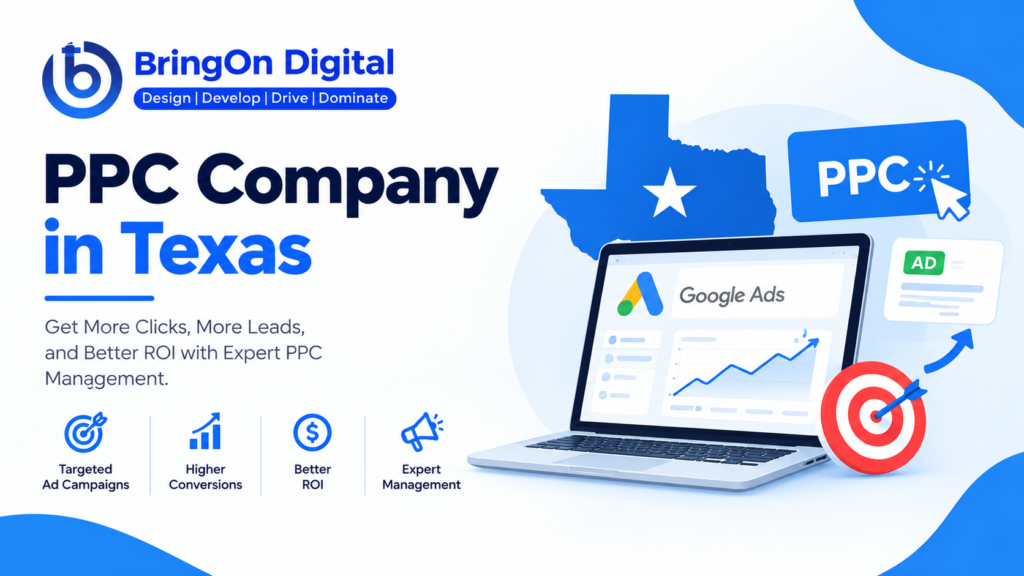
If you are looking for PPC services in Texas, choose a provider that can target Texas city by city, run Spanish-language campaigns, track calls and offline sales back to your CRM, and let you own your ad accounts.
Texas is too big and varied to treat as one market. A good partner plans budgets and keywords separately for Houston, Dallas–Fort Worth, Austin and San Antonio.
This guide covers what to expect, which platforms suit which businesses, what a good monthly report looks like, and a checklist to use before you sign. Whether you are hiring your first Google Ads agency in Texas or replacing one that let you down, the goal is the same: transparent spend, real leads and the data to prove it.
Why Texas needs a city-level PPC strategy
Every big Texas metro behaves like its own market. Cost per click, competitors and customer intent can differ a lot, even for the same service.
- Houston: Large, spread out and industrial. Demand is strong in energy, healthcare, construction, logistics and home services. Long drive times make radius targeting important.
- Dallas–Fort Worth: A huge metro with many suburbs, such as Plano, Frisco, Arlington and Irving. Corporate, B2B, real estate and professional services compete hard here.
- Austin: Tech, startups, a young workforce and fast growth. Software, SaaS, fitness, food and home services are all competitive.
- San Antonio: A large Hispanic population, a military community and tourism. Bilingual campaigns and local trust signals often matter most.
Why it matters: One statewide campaign usually spends most of its budget in the city with the most searches, not the city where you earn the most. Splitting campaigns by metro lets you control budget, bids and messaging.
Location targeting: city, ZIP code or radius
Google Ads, Microsoft Ads and Meta all let you target by city, ZIP code or a radius around an address. A good provider chooses these deliberately:
- Radius targeting suits businesses customers travel to, such as clinics, restaurants and showrooms.
- ZIP or city targeting suits service-area businesses, such as plumbers, roofers and HVAC companies. Exclude areas you do not cover.
- Location options: Target people in or regularly in your area, not just people interested in it, unless you want visitors or people relocating.
- Bid adjustments: Raise bids where conversion rates are higher, based on real data.
Tip: Ask any provider how they will set up locations for your account. If the answer is “all of Texas,” ask why.
Spanish-language campaigns
Many Texans, especially in San Antonio, Houston, El Paso and the Rio Grande Valley, search in Spanish or switch between languages.
A strong Spanish campaign needs three things:
- Spanish keywords
- Ad copy written by a fluent speaker
- Spanish landing pages
Sending Spanish searchers to an English page usually hurts results. You also need someone who can answer calls, forms and chats in Spanish. Otherwise the leads are wasted.
Which ad platform fits your business?
You do not need every platform. A good PPC company in Texas recommends platforms based on how your customers buy, not on what the agency likes to sell.
| Platform | Best for | Why |
| Google Ads | Local and emergency services, healthcare, legal, B2B, e-commerce | Reaches people already searching for what you offer. Search, Performance Max, Shopping and local service ads cover most needs. |
| Microsoft Ads | B2B, professional services, older audiences | Shows ads on Bing and partner sites. Skews towards desktop and office workers. Often less competition, and you can usually import Google campaigns. |
| Meta ads (Facebook and Instagram) | Consumer brands, restaurants, events, real estate, fitness, e-commerce | Creates demand rather than capturing it, so it needs good creative and a clear offer. Lead forms work well with fast follow-up. |
| B2B companies selling high-value services or software | Targets by job title, company size and industry. Costs more per click, but can reach decision-makers in Dallas or Houston. |
How to think about budget
There is no single right budget. It depends on your industry’s cost per click, the number of cities you target and how many leads you need. A small local business might start with a modest test on one platform in one city. A multi-location company may need much more.
Work backwards:
- Estimate how many leads you need.
- Estimate your likely conversion rate.
- Work out what a customer is worth.
Your provider should then tell you honestly whether your budget can produce meaningful data in your chosen cities, or whether you should narrow your focus first.
Check how they charge. Common models are a flat monthly fee, a percentage of ad spend, or a mix. Ad spend should be billed by the platform straight to your card or invoice, never marked up through the agency.
Tracking: the part most campaigns get wrong
Without accurate tracking, you are optimizing for clicks, not customers. Make sure these are in place before you scale.
Conversion tracking
Track every important action: form submissions, bookings, purchases, chat starts and phone calls. Set this up through Google Tag Manager or the platform’s own tags, and test each one. Broken tracking is so common that our analytics and consulting team often starts here.
Call tracking
For many Texas service businesses, most leads come by phone. Call tracking with dynamic numbers shows which campaign, keyword and city produced each call. You can also record or score calls for quality.
Offline conversions and CRM
This is the most valuable step. When a lead becomes a quote or a closed sale, your CRM sends that data back to Google or Meta. The platforms can then optimize for real revenue, not just form fills. If your current CRM cannot do this, look at CRM development options that can.
What a good monthly PPC report includes
A report should help you decide what to do next. If you cannot tell what happened and what comes next, it is not doing its job. Look for:
- Spend, leads or sales, and cost per lead or return on ad spend, by platform and by city
- Lead quality notes, ideally using CRM data on which leads became customers
- Best and worst keywords, ads and audiences
- A search term review, including which negative keywords were added and why
- Tests run during the month and what you learned
- A short plan for next month, with any budget recommendations
A short review call alongside the report lets you ask questions and agree on priorities.
Contract and account-ownership checklist
Before signing with any Google Ads agency in Texas, confirm each of these:
- You own the Google Ads, Microsoft Ads, Meta Business Manager and LinkedIn Campaign Manager accounts. The agency is added as a manager or partner.
- You own Google Analytics, Google Tag Manager and any call-tracking account, or at least have admin access.
- Ad spend is billed directly to you by the platform.
- Management fees, setup fees and any extra charges are in writing.
- The notice period is reasonable (often 30 days) with no penalty for leaving.
- Landing pages, ad creative and copy built for you are yours to keep.
- The provider will hand over all access cleanly if you end the contract.
8 questions to ask any PPC provider
- How will you structure campaigns across the Texas cities I serve?
- Will you run Spanish-language campaigns, and who writes the Spanish copy?
- Which platforms do you recommend for my business, and why?
- How will you track calls, forms and offline sales?
- Can you send conversions from my CRM back to the ad platforms?
- What does your monthly report look like? Can I see a sample?
- Who will manage my account day to day, and how often will we talk?
- Do I own all accounts and data from day one?
How PPC fits with SEO and lead generation
PPC gives you fast, controllable visibility. SEO builds traffic that keeps coming when the budget stops. Search term data from paid campaigns shows which keywords actually convert, which helps your SEO in Texas strategy focus on the right topics.
PPC also works best as part of a full funnel: strong landing pages, fast follow-up and nurturing for leads who are not ready to buy yet. Our lead generation and funnel building work ties these pieces together.
Working with BringOn
BringOn Digital is a Google Partner and Meta Business Partner with an office in Plano, Texas and a delivery team in Noida, India. We have managed more than ₹186 crore in ad spend for clients across several countries.
Want a second opinion on your current campaigns, or a proposal you can compare using the checklist above? Explore our PPC services or contact our team.
Frequently asked questions
How much do PPC services in Texas cost?
It depends on your industry, cities and platforms. Management fees are usually a flat monthly fee or a percentage of ad spend, and vary widely by scope. Ad spend is separate and paid directly to the platform.
Should I target all of Texas or specific cities?
Usually specific cities or service areas. Separate campaigns or ad groups for each metro give you control over budget, bids and messages, and stop one big city from absorbing all your spend.
Is Google Ads or Meta better for a Texas business?
Google Ads is generally better for capturing existing demand, like people searching for a service right now. Meta is better for creating demand with visual offers. Many businesses use both, starting with whichever matches how their customers buy.
Do I need Spanish-language PPC campaigns in Texas?
If a meaningful share of your customers speaks Spanish, yes. Use Spanish keywords, ads and landing pages, and make sure your team can respond in Spanish.
What are offline conversions?
These are sales or qualified leads recorded in your CRM after the click, such as a signed quote. Sending this data back to Google Ads or Meta lets the platforms optimize for real customers instead of form fills.
What happens to my ad accounts if I change agencies?
Nothing should be lost. If your business owns the accounts, you simply remove the old agency’s access and add the new one. All history and data stay with you.