Picture two brands selling the exact same product at the exact same price. One posts randomly whenever someone on the team remembers to. The other has a team that plans content, runs ads, tracks numbers, and adjusts every week based on what’s working. Guess which one grows faster?
That second brand is almost always working with a social media agency and the gap between “posting” and “strategic social media management” is where most of the return on investment (ROI) hides.
If you’ve ever wondered what you’re actually paying for when you hire a social media agency, or whether it’s worth the money, this guide breaks down every major service these agencies offer and shows exactly how each one turns into real business results: more traffic, more leads, and more revenue.
What Is a Social Media Agency, Exactly?
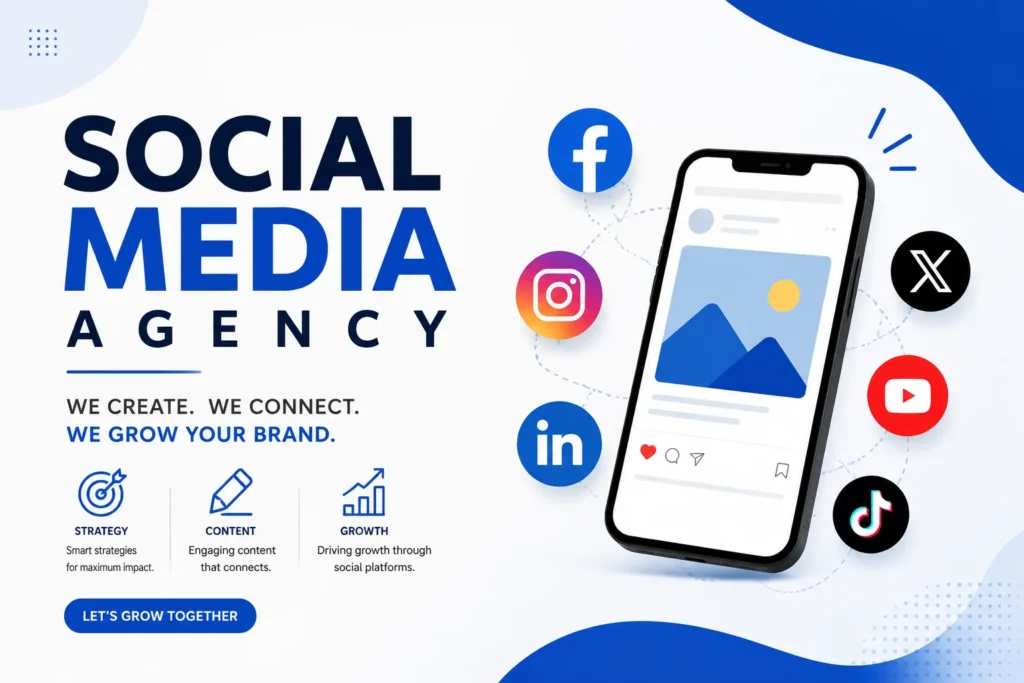
A social media agency is a team of specialists, strategists, designers, copywriters, ad managers, and analysts who manage a brand’s presence across platforms like Instagram, Facebook, LinkedIn, TikTok, and YouTube. Instead of hiring five different people in-house, you get an entire skill set under one roof.
But here’s the part most business owners miss: a good agency isn’t just “posting content.” It’s running a system where every piece of content, every ad dollar, and every comment reply is working toward a measurable goal. That’s exactly why understanding their services matters because once you know what should be happening behind the scenes, you can actually judge whether you’re getting your money’s worth.
Social media isn’t optional anymore either. Global spending on social media advertising is projected to cross $317 billion in 2026, and well-run campaigns are typically landing between 250% and 500% ROI meaning $2.50 to $5 back for every dollar spent, according to industry benchmark reports. That’s a big enough number that it pays to understand exactly where it comes from.
Let’s break down the services, one by one.
1. Social Media Strategy Development
Before a single post goes live, a good agency builds a roadmap. This is the foundation everything else sits on, skip it, and you’re just guessing.
Audience research and competitor analysis come first. The agency studies who your ideal customer is, what they scroll past, and what makes them stop. At the same time, they study your competitors, what’s working for them, what’s flopping, and where the gaps are that you can fill.
Platform selection follows naturally from that research. Not every brand needs to be on every platform. A B2B software company probably gets more value from LinkedIn than TikTok, while a fashion brand might see the opposite. A strategist matches the platform to where your actual buyers spend their time, instead of spreading your budget thin across places that don’t convert.
ROI impact: This step alone prevents wasted spend. Without it, brands often throw money at the wrong platform or the wrong audience, the single biggest reason social campaigns underperform.
2. Content Creation and Curation
This is the part most people picture when they think “social media agency” but it’s more layered than it looks.
Graphic design and video production turn ideas into scroll-stopping visuals. Short-form video in particular has become the highest-ROI content format across the board, with several 2026 industry reports showing it consistently outperforming static images and long-form video for both engagement and conversions.
Copywriting and captions matter more than people expect. A great visual with a weak caption still underperforms. Agencies write copy that hooks attention in the first line, matches the brand’s voice, and includes a clear reason for someone to comment, share, or click.
ROI impact: Video-based campaigns have been shown to generate noticeably higher conversion rates than static ads. Better content isn’t just prettier, it directly drives more clicks and sales.
3. Social Media Management and Scheduling
This is the “engine room” of the agency’s work, the day-to-day operations that keep your brand active and responsive.
Posting consistency sounds simple, but it’s one of the biggest reasons brands lose momentum. Platform algorithms reward accounts that post regularly, and audiences forget brands that go quiet for weeks. Agencies use scheduling tools to maintain a steady rhythm without anyone forgetting to hit “publish.”
Community engagement and comment management is where trust is built. Replying to comments, answering DMs, and handling questions in real time shows your audience there’s a real business behind the account. This matters more than most brands realize a large share of consumers say they’ll switch to a competitor if a brand stays silent on social media.
ROI impact: Consistency and responsiveness both feed directly into brand loyalty, and loyal followers convert into repeat customers a far cheaper source of revenue than constantly chasing new ones.
4. Paid Social Media Advertising
Organic posting builds a relationship. Paid advertising accelerates growth. Most agencies combine both.
Ad campaign setup across platforms like Meta (Facebook and Instagram), LinkedIn, and TikTok involves choosing the right objective (awareness, traffic, leads, or sales), building the audience targeting, and designing ad creative that actually performs.
Budget optimization and A/B testing is where the real skill shows. Agencies test different headlines, images, and audiences against each other, then shift budget toward whatever is winning. This ongoing testing is a major reason paid social campaigns can achieve strong, repeatable returns instead of one-off lucky wins.
ROI impact: Well-managed paid social campaigns are commonly cited as delivering somewhere in the 3:1 to 5:1 return range as an industry baseline, with top-performing campaigns going well beyond that. The difference between a mediocre campaign and a great one often comes down to how disciplined the testing process is which is exactly what an experienced agency brings.
5. Influencer Marketing
Influencer marketing has grown from a nice-to-have into a core strategy for most brands.
Influencer identification and outreach involves finding creators whose audience actually overlaps with your target customer, not just picking the account with the most followers. Smaller “micro” and “nano” influencers often produce stronger engagement than big-name creators because their audiences trust them more.
Campaign tracking and performance means the agency doesn’t just launch the partnership and hope for the best. They track clicks, promo code usage, and conversions tied to each creator, so you know exactly which partnerships are worth repeating.
ROI impact: A large majority of organizations report that influencer marketing outperforms traditional digital advertising, and many brands find influencer-driven content earns significantly more trust than branded content alone trust that translates directly into purchases.
6. Analytics and Performance Reporting
You can’t improve what you don’t measure. This is the service that separates agencies that guess from agencies that actually optimize.
Key metrics tracked typically include engagement rate, reach, click-through rate, and most importantly conversions and revenue. Vanity metrics like follower count matter far less than whether the activity is actually driving business outcomes.
Monthly or quarterly reporting keeps you in the loop. A good agency doesn’t just send a spreadsheet full of numbers; they explain what the numbers mean and what’s changing next based on the data.
ROI impact: Interestingly, one of the biggest challenges marketers report is accurately measuring ROI in the first place many admit they struggle to prove exact returns. Agencies that build strong reporting systems give you something rare: real clarity on whether your budget is working, instead of just a gut feeling.
7. Brand Reputation Management
Social media is a two-way street, and not every comment will be positive. How a brand handles that says a lot.
Handling negative feedback professionally and quickly can turn an unhappy customer into a loyal one. Agencies typically have response protocols ready so nothing sits unanswered for days.
Crisis management strategies come into play when something goes wrong publicly, whether it’s a product issue or a PR misstep. Having a plan ready before a crisis hits is the difference between a brand that recovers quickly and one that spirals.
ROI impact: Reputation directly affects purchase decisions. Customers research brands on social media before buying, and a poorly handled complaint left visible for the world to see can quietly cost far more in lost sales than any single ad campaign could recover.
8. Social Media Audits
Before improving anything, a smart agency looks at where you currently stand.
Identifying gaps and opportunities means reviewing your existing profiles, content performance, and audience flagging what’s working, what’s wasted effort, and what’s missing entirely.
Competitor benchmarking compares your performance against similar businesses in your space, so you know whether you’re actually behind, on par, or ahead instead of guessing.
ROI impact: An audit often uncovers quick wins, an outdated bio, a missing call-to-action, an underused platform that costs nothing to fix but immediately improves performance.
How These Services Directly Impact ROI
Here’s a quick summary table connecting each service to the business outcome it drives:
| Service | Primary Business Outcome |
| Strategy Development | Prevents wasted budget by targeting the right audience and platform |
| Content Creation | Increases engagement and click-through rates |
| Management & Scheduling | Builds consistency, trust, and repeat customers |
| Paid Advertising | Drives measurable, scalable revenue growth |
| Influencer Marketing | Builds trust faster than branded content alone |
| Analytics & Reporting | Reveals what’s actually working, so budget goes further |
| Reputation Management | Protects customer trust and reduces lost sales |
| Social Media Audits | Uncovers quick, low-cost performance wins |
How to Choose the Right Services for Your Business
Not every brand needs every service listed above, at least not right away. Before signing with an agency, ask yourself:
- What’s my main goal right now? Brand awareness, lead generation, and direct sales each call for a different mix of services.
- Where does my audience actually spend time? There’s no point paying for TikTok content if your customers live on LinkedIn.
- Do I have any content or data already? If you’ve never tracked performance, an audit and reporting setup should come first.
- What’s my realistic budget? It’s usually smarter to do two or three services well than to spread a small budget across everything.
A transparent agency will help you prioritize based on your goals and budget, rather than upselling every service on the list.
Related reading: top 10 social media marketing agencies in India
FAQs
1. How much does it cost to hire a social media agency?
Costs vary widely depending on the scope of services, but many small-to-mid-sized businesses spend a few thousand dollars per month for a full-service package covering strategy, content, and management.
2. How long does it take to see ROI from a social media agency?
Organic growth (engagement, community building) often takes two to three months to show clear results, while paid advertising can show measurable returns within the first few weeks once campaigns are optimized.
3. Do I need both organic and paid social media services?
Most brands benefit from a mix of both. Organic content builds long-term trust and brand voice, while paid advertising accelerates reach and conversions in the short term.
4. Can a social media agency guarantee results?
No agency should promise guaranteed follower counts or sales, since results depend on many factors including industry, competition, and budget. A trustworthy agency will focus on realistic benchmarks and continuous optimization instead.
5. What’s the difference between a social media agency and a freelancer?
A freelancer typically covers one or two skills (like content creation), while an agency brings a full team of strategists, designers, ad specialists, and analysts working together under one strategy.
Conclusion
A social media agency isn’t just a team that posts pretty pictures, it’s a system of strategy, creativity, advertising, and data working together toward one goal: turning your social presence into real business growth. Each service on this list plays a specific role, and when they work together, the ROI compounds.
If your current social media efforts feel scattered or you’re not sure whether they’re actually paying off, it might be time to bring in a team that treats social media like the revenue channel it’s become.