Picking the wrong agency doesn’t just waste your marketing budget. It costs you six months you can never get back, while a competitor quietly eats your market share. That’s the real risk in 2026 not “will they run some ads,” but “will they actually move revenue.”
Introduction
Search itself has split in two. Half your customers still Google things. The other half are asking ChatGPT, Google AI Overviews, or Perplexity to just tell them the answer no clicking required. At BringOn, our view is simple: a digital marketing agency in India today has to win in both worlds the old blue-link search and the new answer-first search while still proving every rupee spent against real revenue, not just impressions. This guide walks you through exactly how to find that kind of partner, step by step, with no fluff.
What Does a Digital Marketing Agency Actually Do in 2026?
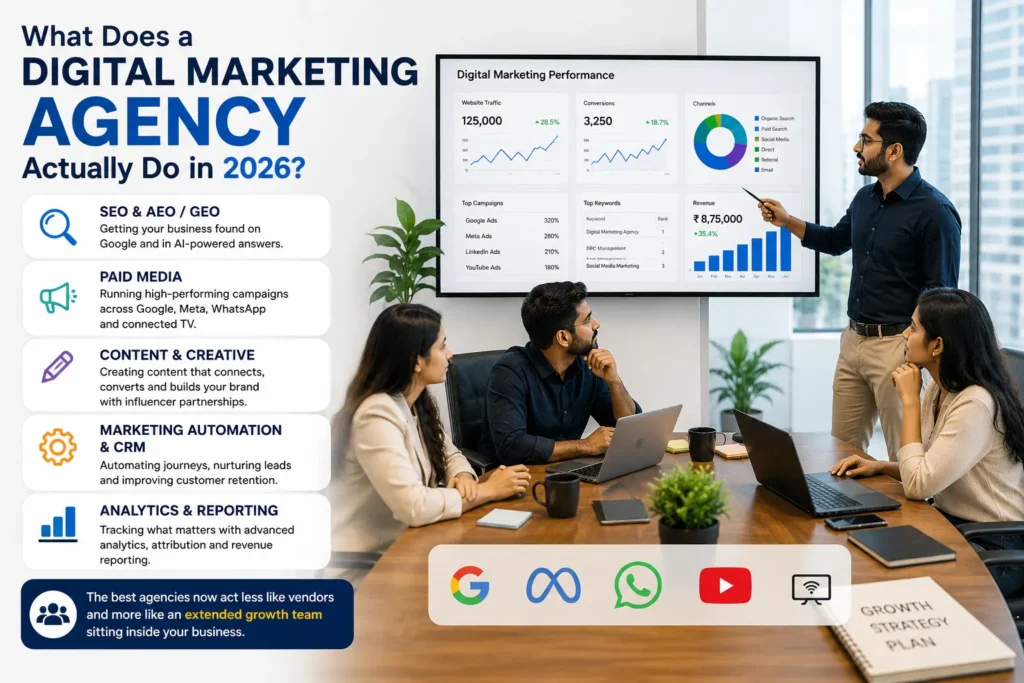
A modern agency is no longer just “the people who post on Instagram.” A capable partner today typically handles:
- SEO and AEO/GEO (getting found in Google and in AI answers)
- Paid media across Google, Meta, and increasingly WhatsApp and connected TV
- Content, creative, and influencer partnerships
- Marketing automation, CRM, and lifecycle/retention marketing
- Analytics, attribution, and revenue reporting
The best agencies now act less like vendors and more like an extended growth team sitting inside your business.
What’s Different About Choosing an Agency in 2026?
Three shifts have changed the buying decision:
- AI has entered the search box. A growing share of queries now get answered directly by AI chat tools instead of a page of links, so being “cited” by AI matters as much as ranking on page one.
- Data is scarcer and more regulated. Cookies are unreliable, so agencies lean harder on first-party data your own WhatsApp lists, CRM, and UPI transaction signals.
- Clients expect revenue proof, not vanity metrics. Impressions and likes no longer justify a retainer; leads, sales, and cost-per-acquisition do.
Step 1 – Define Your Goals, KPIs, and Budget
Before you talk to a single agency, write down three things: what you want to achieve (leads, sales, app installs, brand awareness), how you’ll measure it (CAC, ROAS, MQLs, organic traffic), and what you can realistically spend each month. Agencies pitch very differently once they know whether you’re chasing awareness or bottom-of-funnel conversions so be specific, not vague.
Step 2 – Match the Agency Type to Your Business Stage
| Agency Type | Best For | Typical Strength |
| Full-service agency | Established brands needing multiple channels | Strategy + execution under one roof |
| Boutique/niche specialist | Startups needing deep expertise in one area (e.g., performance ads) | Sharper focus, often faster turnaround |
| Freelancer/consultant | Very early-stage, tight budgets | Low cost, limited bandwidth |
| In-house + agency hybrid | Scaling companies that want control plus outside expertise | Best of both, but needs coordination |
Regional Growth: How the Right Agency Adapts Content for Bharat
If you’re selling beyond metro India, a good agency won’t just translate your ad copy it will rebuild the strategy around regional language content, vernacular video, and platforms that over-index in Tier 2 and Tier 3 cities, like regional YouTube channels and local-language search. This “Bharat-first” approach is often where the real growth is hiding for Indian brands.
Step 3 – Evaluate Track Record (Beyond the Pitch Deck)
Case studies in a slide deck are easy to make impressive. Ask instead for client references you can actually call, real before-and-after numbers (not just percentages ask for the base numbers too), and how long their average client relationship lasts. Long retention is one of the most honest signals of agency quality.
Inside a Good Agency: Team, Process, and Quality Control
Ask who will actually work on your account, not just who’s in the pitch meeting. Good agencies will show you their reporting cadence, their QA process before anything goes live, and a named point of contact not a rotating cast of juniors.
Step 4 – Check AI and Modern Search Capabilities (AEO/GEO)
By 2026, a meaningful share of organic discovery is shifting from traditional search clicks toward AI chatbots and assistants answering questions directly. Ask any shortlisted agency two direct questions: “How do you structure content so AI tools cite us as a source?” and “How do you track whether our brand shows up in ChatGPT, Gemini, or AI Overviews answers?” If they only talk about keyword rankings, that’s a red flag AEO (Answer Engine Optimization) and GEO (Generative Engine Optimization) now sit alongside traditional SEO, not instead of it.
First-Party Data Strategy: WhatsApp, UPI, and India-Ready Funnels
India’s digital funnel looks different from the West. WhatsApp Business is often the real conversion channel, and UPI transaction data can reveal purchase intent that cookies never could. Ask how the agency plans to build funnels around WhatsApp catalogs, click-to-WhatsApp ads, and first-party customer data this is now table stakes for serious Indian e-commerce and D2C brands.
AI With Guardrails: How BringOn Digital Ensures Quality, Not Just Speed
AI tools can draft content fast, but speed without oversight creates generic, error-prone output and worse, content that AI search engines actively distrust. BringOn treats AI as an assistant, not the author: every piece of AI-assisted content goes through human fact-checking, brand-voice editing, and a citation-worthiness review before it’s published, so speed never comes at the cost of accuracy or trust.
Step 5 – Understand Pricing, Contracts, and What “Cheap” Really Costs
| Pricing Model | How It Works | Watch Out For |
| Fixed monthly retainer | Flat fee for defined scope | Scope creep, unclear deliverables |
| Percentage of ad spend | Fee tied to your media budget | May incentivize higher spend, not better results |
| Project-based | One-time fee for a defined project | Unclear post-launch support |
| Performance-based | Pay tied to results (leads, sales) | Can push short-term tactics over long-term brand health |
A shockingly low quote almost always means junior staff, templated strategies, or hidden costs later. Ask exactly what’s included, what counts as a change request, and what triggers extra billing.
India-Specific Compliance: GST, Reverse Charge, and Contract Basics
Digital marketing and advertising services in India attract 18% GST, and agencies must quote and bill using SAC code 998361. If you’re paying an overseas agency or platform (say, a US-based freelancer or foreign ad platform) directly, GST becomes payable by you under the Reverse Charge Mechanism (RCM) so factor this into your budgeting and ask any agency, Indian or foreign, exactly how GST will appear on your invoice. Also confirm PAN, GST registration, and a written contract before any payment; verbal agreements offer zero protection if things go wrong.
Step 6 – Clarify Ownership, Reporting, and Exit Terms
Before signing, get clear written answers on: who owns your ad accounts, website, and creative assets if you leave; how often you’ll get reports and in what format; and what the notice period and exit process look like. Agencies that hesitate to answer these questions plainly are usually agencies you should avoid.
From Impressions to Revenue: What a 2026 Reporting Dashboard Should Look Like
A modern reporting dashboard should connect marketing activity all the way to revenue not stop at clicks and impressions. Look for reports that show cost-per-lead and cost-per-sale (not just cost-per-click), AI-search visibility and citation tracking alongside traditional rankings, and channel-wise ROI so you can see exactly where your money is working hardest.
Before You Commit – Run a Trial Project
Never sign a 12-month contract on a first meeting. A paid 30–60 day pilot on one channel tells you far more about an agency’s real capability than any pitch deck.
Sample 60-Day Pilot Plan You Can Copy
| Days | Focus | What to Evaluate |
| 1–15 | Audit + strategy + tracking setup | Depth of research, clarity of plan |
| 16–35 | Campaign/content launch | Speed, creative quality, communication |
| 36–50 | Optimization based on early data | How they react to real numbers |
| 51–60 | Full report + next-phase proposal | Honesty about what worked and what didn’t |
Red Flags to Watch Out For
Be cautious of agencies that guarantee “#1 ranking” or a specific number of leads, refuse to share client references, avoid discussing pricing clearly, use only vanity metrics (likes, followers) in reports, or lock you into long contracts with no exit clause.
Local vs Remote Agency in India – Does Location Matter?
Location matters less than it used to, thanks to video calls and cloud dashboards but a local agency can still help for hyper-local businesses (real estate, clinics, restaurants) that need on-ground knowledge of a specific city or region. For most D2C, SaaS, and pan-India brands, capability matters far more than the agency’s pin code.
Quick Checklist – Are You Ready to Choose?
- Goals and KPIs written down clearly
- Budget range decided
- Shortlist of 3–5 agencies with verified references
- AEO/GEO capability confirmed, not assumed
- GST and contract terms reviewed
- Ownership and exit clauses discussed
- Trial project scoped before a long-term deal
Industry Playbook: How Selection Criteria Change by Business Type
| Business Type | Priority When Choosing an Agency |
| D2C/E-commerce | Performance marketing, WhatsApp/UPI funnels, creative testing speed |
| Local services | Local SEO, Google Business Profile, review management |
| B2B/SaaS | LinkedIn, content authority, long sales-cycle nurturing, AEO for research-stage buyers |
| Startups | Lean budgets, flexible scope, founder-level communication |
How to Get Internal Buy-In: Pitching a Digital Marketing Agency to Your Team
If you need leadership sign-off, frame the pitch around cost of inaction rather than just the agency’s fee. Show the current gap (say, competitors outranking you in AI search or organic traffic), attach the pilot-project plan so the ask feels low-risk, and commit to a specific check-in date to review real numbers not vague promises.
FAQs
How much does a digital marketing agency in India cost?
Retainers commonly range from ₹25,000 to several lakhs per month depending on scope, team size, and channels always confirm what’s included before comparing prices.
How long before I see results?
SEO and AEO typically take 3–6 months to show meaningful movement; paid media can show results within weeks, though optimization continues throughout.
Is a cheaper agency ever a good idea?
Sometimes, for very early-stage, single-channel needs but always verify what “cheap” excludes, since hidden costs usually surface later.
Do I need a separate agency for AI search (AEO/GEO)?
Not necessarily many capable agencies now fold AEO/GEO into their core SEO and content offering, but you should confirm they’re actively doing it, not just claiming it.
Conclusion
Choosing a digital marketing agency in India in 2026 isn’t about finding the flashiest pitch deck it’s about finding a partner who can prove impact in both traditional search and AI-driven search, who’s transparent about pricing and ownership, and who treats your business like their own. That’s the philosophy BringOn Digital builds every client relationship on. If you’re ready to find a partner who thinks this way, let’s talk.